By Sophie Austin
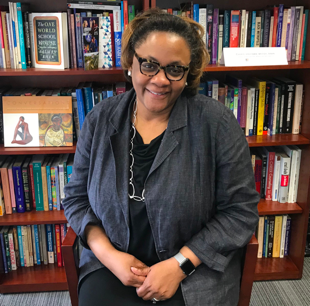
WASHINGTON – Cheryl Holcomb-McCoy attended segregated schools until she entered the third grade. Now she is working to spread awareness about an opportunity gap experienced by students of color and low-income students.
Holcomb-McCoy became the dean of American University’s School of Education in 2016, and she helped launch the dual enrollment program last year that allows senior high school students in Washington to take education courses at American.
For students in the program who later attend American, they will then have a pathway to becoming teachers at public schools within the District, she said.
“The goal of such a program is really to give a head start to students so that they can be ahead of their classes when they come in,” she said. “But it’s also a way for us to build more diversity in the teacher pipeline.”
Holcomb-McCoy’s interest in education comes in part from her parents’ careers as teachers, even though she was not initially drawn to the idea of a career in the field.
“They didn’t tell me not to be an educator, but I think they dreamed of me going into another field,” she said of her parents. “I did everything to stay away from education and look where I ended up.”
During college, her plans changed.
She became a tutor at a Title I school, which means it received financial assistance from state educational agencies and had a large population of low-income students, according to the National Center for Education Statistics.
She tutored second-graders who read below grade level or couldn’t read at all, she said. The experience helped her realize she wanted to pursue a career in education.
Holcomb-McCoy received a bachelor’s degree in early childhood education from the University of Virginia, and later became a kindergarten teacher.
“Most kindergarteners are going through humongous change,” she said. “I deal a lot with change management in my job as dean.”
She later became a school counselor and then conducted research on counselors’ ability to interact with students with different cultural backgrounds.
In 2007, she published a book, “School Counseling to Close the Achievement Gap: A Social Justice Framework for Success.” It addressed how factors such as racism, sexism, heterosexism and classism can contribute to academic challenges for students.
If she could rewrite that book now, she would replace “achievement gap” with “opportunity gap,” she said.
“That gap is not about the ability to learn,” she said. “It’s about the lack of opportunity.”
Holcomb-McCoy’s research includes a 2009 study she conducted with long-time friend Cheryl Moore-Thomas and others, to find out which students visit their school counselors the most in search of college information.
Years ago, Moore-Thomas, who is the associate vice president for faculty affairs and diversity at Loyola University Maryland, and Holcomb-McCoy were school counselors in the same region of Montgomery County, Moore-Thomas said.
Part of the reason they have remained friends for so long is because they share a set of core values, she said.
“She lives her commitment to advocacy,” Moore-Thomas said.
Norma Day-Vines, associate dean for faculty development at the Johns Hopkins University School of Education, was also a part of the group that conducted the 2009 study.
Day-Vines said Holcomb-McCoy provided her with valuable professional mentorship.
“Moving through the ranks in academia is not easy, and the process is often implicit,” Day-Vines said. “She helped to make that process transparent.”
Before becoming a dean at American, Holcomb-McCoy served as vice provost for faculty affairs and vice dean of academic affairs at Johns Hopkins’ School of Education.
While she was hired at American to transform the School of Education, she now has plans to make the school independent from the College of Arts and Sciences so that the education program can become “fully realized as a discipline that the university can be known for.”
Administrators will decide whether this becomes a reality during a vote in May, Holcomb-McCoy said.
Toks Fashola, a research professor at the school, came to American in 2017 after working with Holcomb-McCoy at Johns Hopkins.
“We respect one another, and we trust one another,” Fashola said of their relationship. “If there is anything ever going on with me, I can approach her.”
Of all the things Holcomb-McCoy has accomplished, she is proudest of being a mother to her children Niles, 19, and Nia, 17. Before an interview, she said she made a promise to be on-time to Nia’s softball game that she would not budge on.
When it comes to her career, Holcomb-McCoy, who keeps photos of her past students in her office, is proudest of the impact she has on students.
“That’s why I’m here,” she said.
 The Washington Most